
The Science Behind Water Softeners

If you think you have hard water, maybe your family or friends are telling you that you need a water softener. Do you ever wonder how water softeners work? What exactly are they recommending you get for your home? There is a science to it and Hague Water has it down to an art. Let us do the honor of breaking down the science behind how water softeners operate.
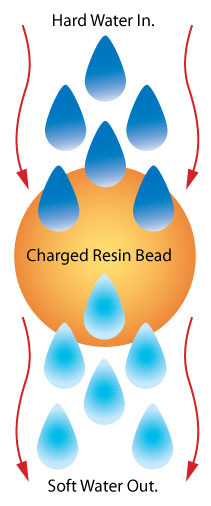
Each water softener contains a bed of resin beads that the water moves through. These small beads are a bundle of polymer that hold a negative electrical charge, like a magnet. At the start of the process, the water is considered hard water because it contains calcium and magnesium from the bedrock the water eroded as it passed through the ground. If left untreated, the calcium ends up clinging to every surface in your home creating crusty white deposits. Not only is that hardness buildup unattractive, it can lead to damage in your water using appliances like coffee pots, washing machines, water heaters, dishwashers, humidifiers, and more.
These hardness minerals (or ions) also naturally carry an electrical charge -- specifically a positive one. So when water that has calcium in it enters a water softener with the negatively charged resin beads inside, the opposites attract. The resin pulls the hardness out of the water and captures it on the surface of the bead, leaving calcium-free or soft water to pass through and into your home.
Every time you turn on a tap, the water goes through the softener to have this hardness captured until the resin beads are full and can't hold anymore. At that time, our Hague Quality Water products go through a regeneration process that essentially cleans off the resin beads so they can collect more hardness again.
In order to do that, a water softener needs salt water (also known as brine). Typically there is a second tank to any water softener system that stores salt that you would replenish occasionally. As needed, the water softener would add water to the salt to dissolve it and then pump it back into the tank that holds the resin beads.
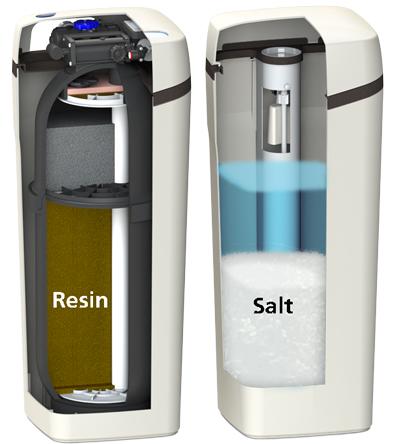 This brine solution is important because the salt compound Sodium Chloride (NaCl) also is a combination of positively and negatively charged ions. Sodium is naturally positive and chlorine is naturally negative. So this time as the salt water passes by the negatively charged resin bead, the same opposites are going to attract. The bead grabs the positive Sodium ion and in order to do so, it must let go of the positive calcium it was hanging on to prior.
The hardness minerals are now free to move out of the water softener but instead of going into your house to deposit scale throughout your house, they are directed down the drain. After the entire regeneration cycle, all of the resin beads are now coated with sodium molecules and ready to go back to capturing calcium and magnesium instead.
The technical term for this constant back-and-forth of resin grabbing hardness minerals, then switching to sodium, and then back to hardness is "ion exchange." The scientific principles are rather simple but it makes a big impact on the quality of your water and the lifestyle you live every day.
Check out the variety of water softening models Hague Quality Water has available to help with your hard water problems. We manufacture some of the most efficient and reliable products available to ensure that investing in quality water is money well spent.

Contact your local authorized Hague Dealer to have a water expert provide you with a free in-home water test and water softener recommendation that is the perfect fit for your home.